The dates, decisions, and documents behind PV’s surveillance program.
Every date links to its agenda title or source record. Meeting titles use the wording in the linked agenda, staff report, or minutes. Other dates identify the document, slide, or publication. Red arrow notes are our commentary. Excerpts and personal detail redactions are labeled.
Council approves a $256,791.26 grant covering plate readers and drones. The minutes describe the plate reader program as a 12 month pilot. The vote passes with 5 in favor and 2 absent.
The signed Flock order lists 15 Falcon plate readers, $45,000 in annual charges, and a $55,750 first year subtotal before tax. The order appears on page 7.
The Town’s June 2025 presentation dates the deployment of the first 15 plate readers to May 2024, covering vehicles entering and leaving Prescott Valley.
The Mountain Valley Park agreement adds 6 combined plate reader and video units, 2 cameras that can pan, tilt and zoom, 4 video gateways, and FlockOS Elite software. It lists $40,000 in annual recurring charges.
The title says border support. The packet says cameras.
An approved $417,489 grant includes $46,872 for plate readers and $21,964 for real time software connecting Town and park cameras. The staff report says future operating costs could rely on grants, opioid funds, or other funding, including the General Fund.
Just plate readers? The minutes have entered the chat.
PVPD reports 26 active plate readers, 6 live view cameras, and about $152,000 in annual costs. The minutes also describe a planned platform to connect camera systems and potential access to business and HOA cameras.
Town Manager Gilbert Davidson signs agreement Q-187512 on March 12. Flock signs on March 13. The 36 month agreement includes FlockOS Plus, 2 plate reader and video bundles, and 5 community camera connections. The $131,250 total excludes tax.
Laura sends the Town a written notice requesting a publicly noticed hearing, a recorded Council vote, the records behind the surveillance program, and preservation of those records. The letter is dated July 12 and signed July 13. The Clerk confirms receipt on July 14.
The PD-2026-280 production contains a 56 page search activity log with 613 entries from June 12 through July 12. It includes users, networks searched, stated reasons, case fields, search times, and search types.
Laura submits her Open Meeting Law complaint to the Arizona Attorney General’s Open Meeting Law Enforcement Team, known as OMLET. It challenges the agenda notices for March 13, 2025 and January 22, 2026, and asks the office to investigate and determine whether the notices complied with the law. The Attorney General acknowledges the complaint on August 6.
Laura asks for a properly noticed, recorded vote on surveillance. Council approves $18,693.39 in opioid settlement funds for narcotics enforcement education, equipment and software. Chief Ticer says there are no plans to put those funds toward plate readers.
Laura identifies August 13 as the 30 day ratification deadline under A.R.S. §38-431.05(B)(1), using the Clerk’s confirmed July 14 receipt of her written notice as the discovery date. During Call to the Public, she asks the Town to identify any different discovery date and its legal basis. The applicable discovery date is an issue in her Open Meeting Law complaint.
Laura returns during Call to the Public. She raises the absence of ratification, outstanding surveillance records including audit and usage logs, and her objection to continued surveillance while authorization and transparency questions remain unresolved. The agenda also includes approval of the August 6 meeting minutes under item 9a.
NextGen Polling releases the privately commissioned Prescott Valley survey on police use of Flock cameras, public approval, and independent audits. The linked release contains the results and survey details.
Laura speaks at the September 24 regular Council meeting. Her appearance follows the September 21 release of the Prescott Valley poll on police use of Flock cameras, public approval, and independent audits.
Goldwater Institute names Prescott Valley among the agencies receiving its records requests. It seeks contracts, camera locations, retention policies, sharing agreements, and rules for searching the data.
“Discussion Only.” The cameras aren’t just discussing.
Laura speaks at the Council study session. The Town’s ALPR presentation lists 798 nationwide law enforcement agencies under data sharing, and the agenda labels the item “Discussion Only.” Her written submission calls for the records, a full independent audit, and a properly noticed Council decision with a recorded vote.
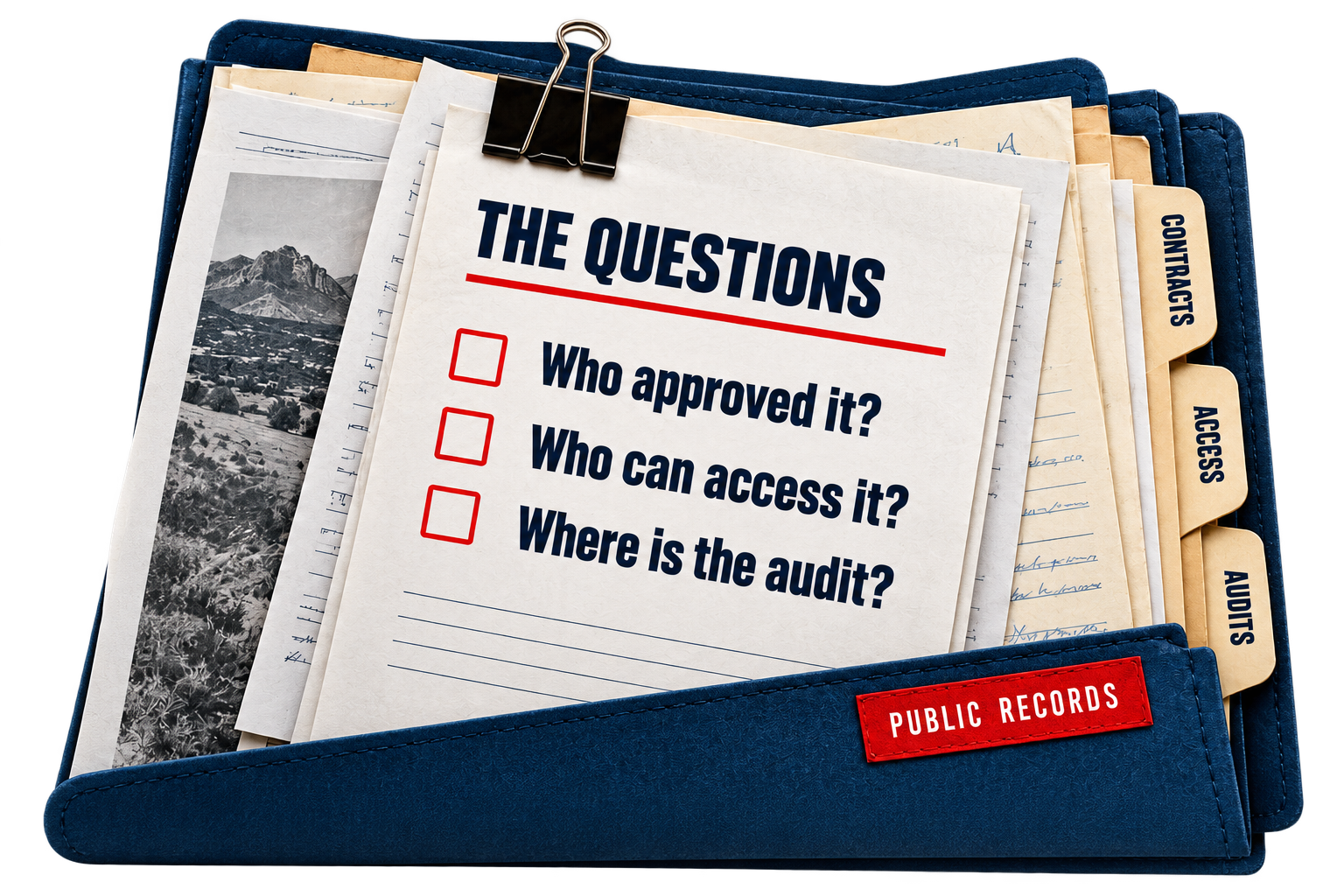
We’re asking what the cameras collect, who can access it, who approved the system, and how anyone checks the answers.
This campaign calls on Prescott Valley to end its ALPR and connected real time surveillance program through a clearly announced public discussion and a recorded Council vote.
We also want the records released, an independent audit of the connected systems and outside access, and a public explanation of termination and equipment removal costs.
Show your work
A few perfectly reasonable questions.
The records explain how the program grew. These are the answers we’re still asking the Town to put on the record.
The signed agreements, approval records, agenda materials, and funding documents should show who authorized the program and its expansion.
Publish the documents. Let people follow the decision.